Tom Hurrle
practices acupuncture in Chicago. He offers Traditional Japanese Acupuncture
- also known as Japanese Meridian Therapy and Japanese Palpatory
Acupuncture. This acupuncture style is rare in Chicago. It very
gentle.
Some
Context: Traditional Japanese Acupuncture
Traditional
Japanese Acupuncture is named for its dedication to ideas originating
in early classic texts of Chinese medicine, which came to Japan
in the 7th century A.D. One of those texts, the Nan Jing

[c.250 A.D.] was taken up by some Japanese practitioners in
the 1920's. They began study groups based on its ideas. They
met and discussed how parts of the text might be applied in
clinical practice. When their discussions reached a point of
agreement, they would test the agreed on technique in their
practices. Meeting again, they compared results. They focused
on point selection, point location, and needle technique. Their
evaluation was clinical: did the techniques work well with their
patients?
They attracted followers because of their clinical success.
The method known as Meridian Therapy blossomed in the '50s and
'60s. Now it is one of many styles practiced in Japan.
Senior teachers began to come to the U.S. in the '80s and '90s.
The Toyohari Association of Tokyo started a wonderful training
program in the early '90s. The delightful Shudo Denmai Sensei
published a fine book Introduction to Meridian Therapy,
translated by Stephen Brown of Seattle, and has taught in the
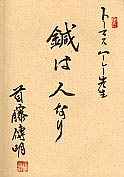
U.S. [See image above: Shudo Sensei autographed Introduction
to Meridian Therapy for me at his 1999 Hawaii seminar. The
inscription reads "Acupuncture is your heart."]
Some practitioners in the U.S. are attracted to Meridian Therapy
because it offers good results with very minimal needle stimulation.
This is a particular advantage in treating people who do not
tolerate "de Qi," a strong sensation at the point
of needle insertion sought in Traditional Chinese Medicine.
Meridian Therapy has come to describe a variety styles originating
around the world. The Meridian Therapy Association of Tokyo,
an umbrella association for the assorted meridian therapy styles
in Japan, adopted the name Traditional Japanese Acupuncture
to reflect the basis of this style in classic texts.
Procedure
I practice Traditional Japanese Acupuncture.
I use very fine needles
[.12mm-.18mm
diameter],
insert them mostly into the skin or subcutaneous tissue, [1mm-4mm],
and often remove the needles in 20 to 40 seconds. I also use moxibustion, a technique for warming acupuncture
points.
NOTE: treatment without insertion of needles is an option.
The
core of a treatment is always the 'root treatment'. Its goal
is to supplement the acupuncture channels of deep internal organs
[kidney, liver, lung, spleen] and uses 2 or 3 "Transport"
points. 1-4 other acupuncture points are used to harmonize or
reduce energy in other acupuncture channels. This tends to normalize
the balance between the sympathetic and parasympathetic nervous
systems. It is profoundly relaxing; it promotes homeostasis
[harmony and efficiency in our organism]. The effect of each
point used in the root treatment is assessed attentively. Pulse
character, skin color and tonus are expected to improve. Treatment
of presenting symptoms follows the root treatment.
Tense,
debilitated or chronically ill people find this treatment restorative
and useful in maintaining their health. Utter absence of side
effects is a key characteristic.
Top
Procedure
Benefits Experience #
treatments required Where
to see me
What
Conditions Benefit?
I am a general practitioner, comfortable
treating most issues. Most people respond well to
acupuncture. Traditional Japanese Acupuncture is particularly
suited to those who are uncomfortable with strong needle
stimulus, or are fatigued or otherwise weakened. I have helped a wide variety of complaints, so the
following examples do not exclude other problems.
Most kinds of pain respond to treatment - headache,
migraine, back pain, neck and shoulder
pain, arthritic pain, and inflammatory conditions
such as bursitis or tendonitis.
Conditions that are aggravated by stress
respond well - anxiety, mild depression, insomnia,
fatigue, dermatitis, dysmenorrhea (PMS) and
perimenopausal
problems.
If the immune system is overactive or under
active, acupuncture helps re-establish balance - allergies,
hay fever, recurrent colds, sinusitis, wheezing
or asthma.
Gastric problems - gastritis, nausea, acid
reflux, difficulty swallowing, Barretts Esophagus
get better when qi circulation is adjusted.
Acupuncture is useful in aiding recovery from
surgery or aggressive medical treatment that leaves the body
weakened. It is useful to ameliorate the side effects of
chemotherapy.
Experience with martial arts training led me to
familiarity with treating trauma - sprains, strains,
bruises, broken bones.
Infertility is often related to insufficient
blood and/or qi. My treatment style is especially suited to
supplementing, building the reserves needed to conceive.
Pediatric treatment without the use of
needles for allergies, asthma, colic, ear infections, ADHD,
Chiari malformation. I am trained in Shonishin, Japanese
pediatric acupuncture.
Treatment reduces the effort needed to maintain
homeostasis; it makes things easier. If you are anxious, tense,
tired of pain, or just worn out you will appreciate this.
Top
Procedure
Benefits Experience #
treatments required Where
to see me
My
Experience
My acupuncture experience in Chicago includes work
in a hospital-based Integrative
Medicine Center, in a geriatric medicine office, and in my home
office. In the first two locations I gained experience
treating those undergoing cancer therapy as well as other
conditions associated with aging.
Since 1997 I have focused exclusively on
developing the art of acupuncture
based on palpation. The sensitivity I use in treatment was first
exercised through the study of shiatsu and energy healing in the
early 1970's. I believe that the practitioner acts as a
conduit for qi. A conduit needs to be open, so I use daily qigong
and seated meditation to cultivate stance and relaxation.
I find that those who are sensitive to changes in
their body/mind respond well. The sensitivity comes many ways:
athletic endeavor, meditation practice, and prolonged mental or
physical discomfort are examples. Children are naturally sensitive
and do respond well.
When treating an acupuncture point, it is
important that there be a sign of effectiveness; this is called
the arrival of Qi. A classic description of the arrival of Qi is:
"It is as though the wind has blown away the clouds, exposing
a clear blue sky". This image conveys the benefit I aim for:
a relief from oppression, a sense of clarity, a feeling of
well-being.
Top
Procedure
Benefits Experience #
treatments required Where
to see me
How
many treatments are required?
Your
general state of health, your lifestyle, and the problem's duration
influence the number of treatments. An otherwise healthy person
may require just two or three treatments. Conditions that have
endured for months or years usually take more.
Treatment
is a learning process; your body learns new patterns of response
and the acupuncturist learns what is most effective for you.
This learning is especially rapid in the first two or three
sessions. Usually five treatments are the point when the results
should be evaluated. In some cases, no more are needed. With
chronic problems longer treatment is often needed, but some
benefit should be felt by this point.
Usually
treatments are weekly, though more often is good for acute symptoms.
When the initial complaint is better, treatment may be continued
at less frequent intervals - biweekly, monthly, quarterly. The
goal is to maintain the pattern of health acupuncture helped
create. Treatment when your complaint is not active helps the
body maintain a higher level of well-being.
Thomas J. Hurrle
I
first studied Oriental healing techniques in 1972 with the
Macrobiotic teacher Michio Kushi. These studies included dietary
therapy and Shiatsu massage, which I have practiced and taught
since that time. My studies have also included Hatha Yoga,
Zen Yoga, Transcendental Meditation, Qigong, Xing Yi and
Ba Gua. I studied the last three
with Wai Lun Choi in Chicago for 6
years. Recently I have the good fortune to study Taoist Qigong
with Eva Wong.
I
graduated from the Midwest College of Oriental Medicine, an
accredited Master's level program, and passed both the acupuncture
and Chinese Herbology national board exams of the National Certification
Commission for Acupuncture and Oriental Medicine [NCCAOM]. I
am a faculty member at Pacific College of Oriental Medicine in
Chicago, and Treasurer of the Illinois Association of
Acupuncture and Oriental Medicine.
I
hold a certificate from the Toyohari Association, Tokyo, Japan
for completion of a course in that delicate style of Traditional
Japanese Acupuncture. I have studied in seminar with senior
Traditional Japanese Acupuncture practitioners, including Shudo
Denmai, Masakazu Ikeda, Aikizo Okada, Michioshi Baba, Sorimachi
Dai-ichi, and Stephen Brown. These studies include a generous
portion of hands on training in palpation and needle technique
that is not available in Illinois at this writing.

Top
Procedure
Benefits Experience #
treatments required Where
to see me
|
Where
To See Me
In Lincoln Square, at the address below.
To schedule: Call 773-878-7150

Tom Hurrle, L.Ac.
2719 W. Ainslie, Chicago, IL 60625
tel. +773-878-7150
fax. +773-878-7153
Diplomate, Acupuncture and Chinese Herbology, NCCAOM
Member Illinois State Acupuncture Association
I'll
be happy to hear your comments or questions.
email: tom@vitaldirections.com
|
Top
Procedure
Benefits Experience #
treatments required Where
to see me